Date: 14-06-2026 at 09:14
It was the year 1954, a boy was born in a doctor’s family in a small town in the northern Kerala state. M. Viswanathan, the boy’s father, was a diabetologist, and his inclination to become a diabetes specialist must have come from his early work.
The Boy completed his MBBS in 1978 and MD in General Medicine in 1981 from Madras Medical College, Chennai. Even before completing his MBBS, the boy started his clinical practice at M.V. Hospital for Diabetes, which was also India’s first private diabetes centre run by his father. The boy is one of India’s most celebrated diabetologists, Dr V Mohan.
Soon after completing his Phd he started Diabetes Specialities Centre on him name in 1991 and founded Asia larest stand alone diabetes research centre, Madras Diabetes Research Foundation (MDRF) in 1996 along with his wife, Dr Rema Mohan.
Dr V Mohan, with over 3 decades of clinical experience in diabetes, published a research paper in 2005 titled “A simplified Indian Diabetes Score for screening for undiagnosed diabetic subjects”. The paper discusses the Indian Diabetic Risk Scoring (IDRS), a non-invasive, simplified, undiagnosed diabetes screening tool.
The IDRS takes four parameters: age, waist circumference, physical activity, and Family history of diabetes. For a total score of 100, a score less than 30 denotes low risk, a score between 30 and 50 denotes moderate risk, and anything above 50 denotes high risk.
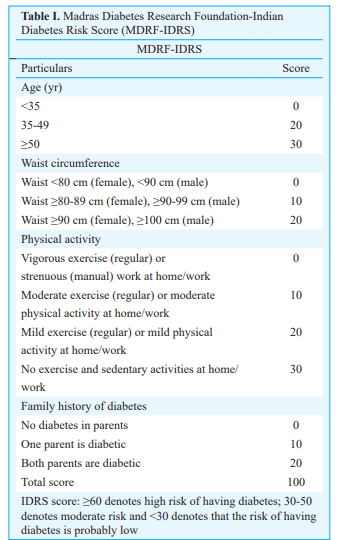
In the past two decades, 50+ studies have been conducted across India using IDRS [1 2 3 4]. The most notable one in 2023 was by ICMR, a population-scale study that includes 113,013 participants from both urban and rural populations from 30 states/union territories in India and found 32.4, 52.7 and 14.9 per cent of the general population were under high-, moderate- and low-risk categories of diabetes.
In the world of LLMs, the temptation to do sophisticated stuff is very hard to resist, but when I look at our country’s healthcare, the population scale outcomes and impact will come from doing simple and boring stuff.
If a simple four-parameter scoring system can have such a massive impact, what kind of impact will a 10X IDRS system have?